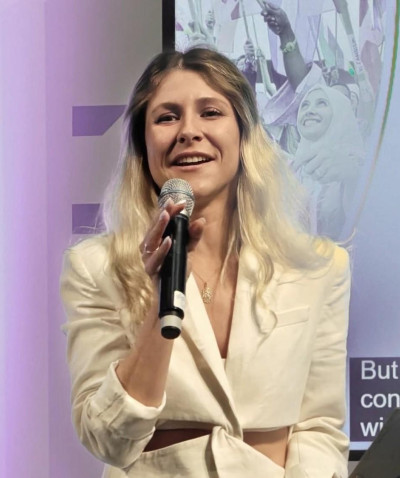
Nationality: German
Member Association past two years: Volt Germany
Gender: Female
What do you see as the most urgent democratic challenge facing Volt Europa's mission across the continent, and how would you lead the organisation's response?
The most urgent democratic challenge facing Volt’s mission is fragmentation, both in European politics and in citizens’ trust in democratic institutions.
Across Europe, political systems remain largely national, while the challenges we face are increasingly transnational. At the same time, declining trust, polarisation and the rise of populist forces are weakening the ability of democracies to act effectively. This creates a gap between what needs to be done and what political systems are able to deliver.
Volt exists to address exactly this gap. But to do so credibly, we must demonstrate that European cooperation is not only necessary, but also workable in practice.
My focus would be twofold.
First, strengthening Volt’s ability to act as a truly European political force by aligning our efforts across countries and delivering more visible, coordinated action on shared priorities.
Second, making democratic impact tangible at local level, showing citizens that participation, transparency and European cooperation lead to real outcomes in their daily lives.
By combining European coordination with local impact, Volt can rebuild trust and demonstrate a model of democracy that is both effective and close to citizens.
How would you handle a public disagreement with your Co-President on a matter of political strategy?
A disagreement between Co-Presidents is not a problem in itself. It is a natural and healthy part of shared leadership in a political movement.
However, as Co-Presidents, we carry a responsibility to provide clarity and stability. Our default should be to align internally and communicate with one coherent voice externally.
My approach would be to address disagreements early and directly, creating space for open and honest discussion. The goal is not to win an argument, but to arrive at the best decision for the movement. This requires trust, mutual respect and a shared commitment to Volt’s long-term goals.
Where alignment is possible, we should achieve it before going public. If full agreement cannot be reached, we still have a responsibility to move forward constructively and ensure clarity in our communication.
In rare cases where differences do become visible, they should be handled with professionalism and respect, focusing on solutions rather than division.
Strong co-leadership is not defined by the absence of disagreement, but by the ability to turn it into better decisions while maintaining trust, unity and direction.
In what way will you ensure the European Board remains accountable to local volunteers and members in practice? Please give 2–3 specific mechanisms.
Ensuring accountability to members requires structured, consistent and accessible feedback loops, not just intentions.
I would focus on three mechanisms:
1. Regular, structured member dialogue
Recurring open sessions where the Board shares updates, explains decisions and actively gathers input, creating real space for questions and discussion.
2. Clear communication and transparency on decisions
Ensuring key decisions, priorities and trade-offs are communicated in a timely and understandable way, and improving information flows across existing platforms.
3. Stronger feedback channels from chapters
Working closely with national leadership and representative bodies to ensure local perspectives are systematically fed into European decision-making and acted upon.
Accountability is not only about reporting back, but about creating continuous dialogue where members feel heard, informed and connected to the organisation’s direction.
Get involved
Become a member or supporter of Volt!