A blueprint for a European Defence Union - by Reinier van Lanschot
Europe's defence problem is not mass or money: it is the absence of a political center of gravity.
European NATO fields two million personnel and spends almost 500 billion euros a year on defence, second only to the US, yet divided across 27 national efforts that add up to far less than the sum of their parts. The US has made a permanent strategic reorientation to the Indo-Pacific, with bipartisan consensus behind it, and is shifting the burden for Europe's conventional defence onto Europeans, unpredictably and on its own timeline. Russia has both the capability and the imperial ambition to test this transition with a direct attack on an EU Member State, possibly well before 2030. Even a limited ground incursion leaves the EU and NATO hours, not days, to prevent a fait accompli and thus at least the end of NATO. NATO 3.0 must therefore become a two-pillar alliance: American and European, equal not just in capabilities but in political control. That European pillar does not yet exist.
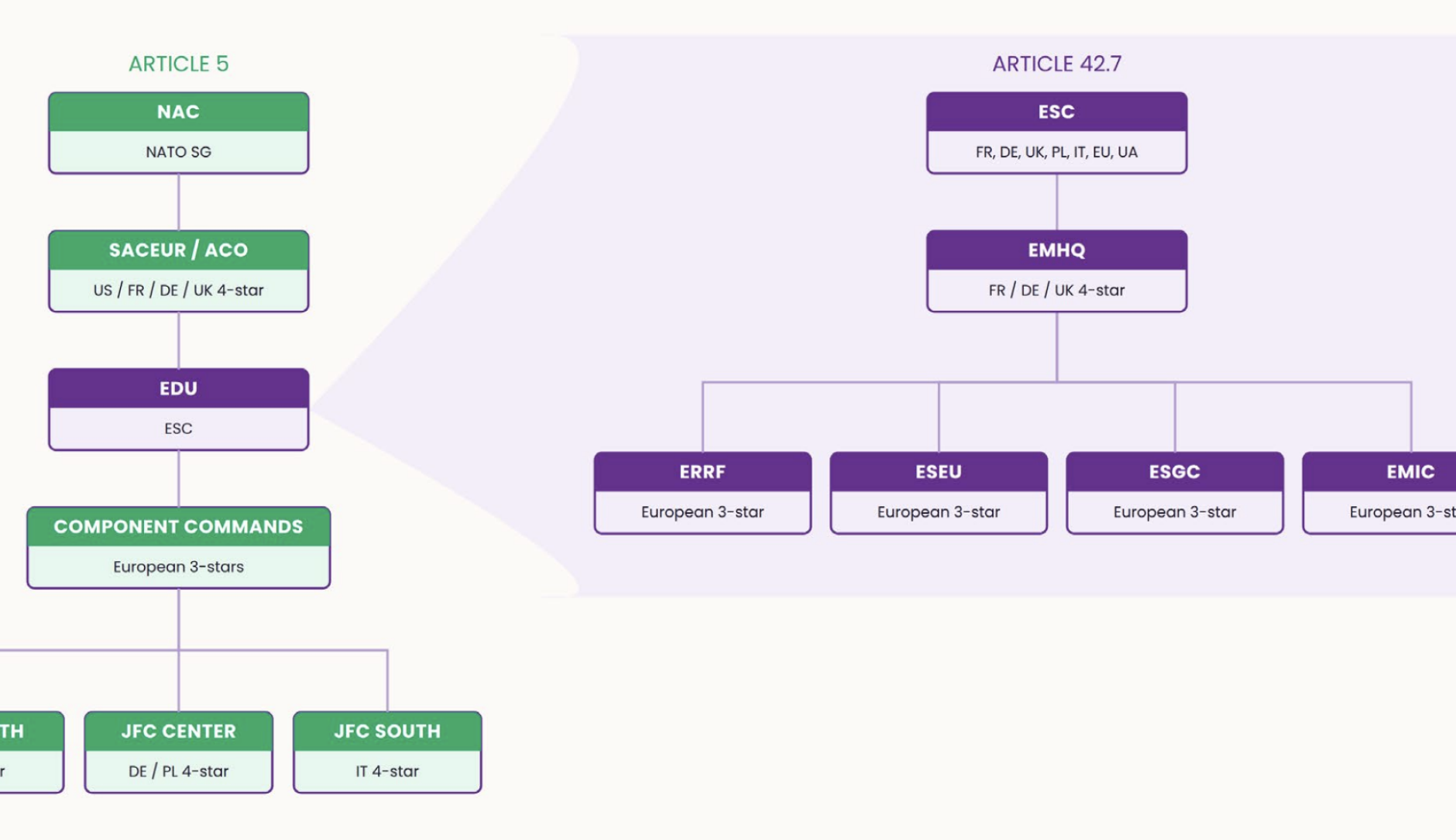
What this blueprint proposes is not an academic ‘’European Army’’, but a counterpart, or eventual replacement, to what US European Command (EUCOM) is today. A ''primus inter pares'' or ‘’operating system’’ glueing together the component parts of European NATO in a double-hatted role, separable, but not separate from NATO. It does not ask Europeans to replicate the US 1-for-1. It asks Europeans to build the one thing no single member state can buy on its own: a politically united centre of gravity for theatre-wide, credible collective deterrence and defence, that can be dynamically scaled up over time, in conditions of peace, war, and in between.
That center of gravity rests on six building blocks, sequenced by urgency and deterrence effect. First, a European Security Council, the political mandate-giver without which nothing else can act fast enough. Second, the operationalisation of article 42.7, so that European deterrence signalling becomes credible rather than theoretical. Third, a European Military Headquarters, providing the theatre-wide command and control that no Joint Force Command or the JEF can replicate alone. Fourth, a European Military Intelligence Center, the eyes and ears without which no political-military decision can be timely, accurate or accountable. Fifth, European Strategic Enablers: capabilities, from air-to-air refuelling to integrated air and missile defence, too expensive for any single state to field alone. Sixth, a European Rapid Reaction Force, able to eject an initial attack from European territory which prevents the need for a long attritional war.
Europe's defence problem is not mass or money: it is the absence of a political center of gravity. What this blueprint proposes is not an academic ‘’European Army’’, but a counterpart, or eventual replacement, to what US European Command (EUCOM) is today.
By Reinier van Lanschot, Volt MEP.